

The Interpretation Economy: Why Clarity Now Determines Opportunity
Most people still think we live in the attention economy. That was true for a while.
Attention became the internet’s dominant currency. The people who could capture attention – creators, platforms, brands, influencers, media companies – gained leverage.
But something deeper is now happening beneath that layer. We are moving into what might best be described as the interpretation economy.
An environment where outcomes are increasingly determined not simply by what you produce, but by:
- how systems interpret you
- how clearly people understand you
- how quickly your value can be recognised
- how accurately your intent survives compression
- how easily your work fits into modern decision environments
In other words:
interpretation itself is becoming economically significant.
This shift affects creators, businesses, consultants, artists, job seekers, agencies, educators, and increasingly almost anyone attempting to create visibility, trust, or opportunity online.
And AI is accelerating it dramatically.
What Is the Interpretation Economy?
The ‘interpretation economy’ is a useful way to describe a modern environment in which:
- algorithms interpret relevance
- AI systems interpret expertise
- audiences interpret trustworthiness instantly
- platforms interpret authority through signals
- users interpret clarity as competence
- overloaded people make compressed decisions rapidly
The internet is no longer simply a publishing environment, it is increasingly an interpretive environment. Modern systems constantly compress, summarise, rank, recommend, filter, and reinterpret information before humans ever encounter it.
Search engines summarise pages. AI systems generate answers. Social platforms decide visibility. People skim instead of reading. Decision-making happens in seconds.
This creates a world where being misunderstood becomes expensive.
Not because you lack skill. But because modern systems reward recognisability.
Why This Matters More Than Most People Realise
Many people are quietly experiencing the effects of the interpretation economy already.
They simply do not have language for it yet.
Examples include:
- highly capable people becoming invisible online
- excellent businesses struggling to convert visitors
- creators producing constantly without gaining traction
- consultants who are good at what they do but difficult to “place”
- websites that confuse instead of orient
- AI systems misunderstanding what someone actually offers
- audiences leaving because they cannot quickly identify relevance
- people feeling cognitively overwhelmed by too many options and signals
In many cases, the issue is not quality. It is interpretation.
The internet increasingly rewards:
- clarity over complexity
- recognisability over nuance
- direction over exploration
- cognitive ease over information density
- immediate orientation over deep explanation
That does not mean depth no longer matters. It means depth must now survive modern interpretation systems.
AI Did Not Create the Interpretation Economy
AI accelerated it.
Long before large language models arrived, algorithms were already shaping visibility and perception.
Social media feeds interpreted relevance. Search engines interpreted authority. Platforms interpreted engagement. Audiences interpreted credibility through fragmented signals.
But AI dramatically increases the speed and scale of interpretation.
Increasingly:
- AI systems summarise expertise
- AI assistants recommend providers
- answer engines compress websites into short responses
- models infer what people “are” from scattered data
- algorithms cluster identities and topics automatically
- discovery becomes mediated through interpretation layers
This changes how people are found. How businesses are understood. How creators become visible. How trust forms. How opportunities emerge.
It also creates a strange new reality:
being competent is no longer enough.
You must also be interpretable.
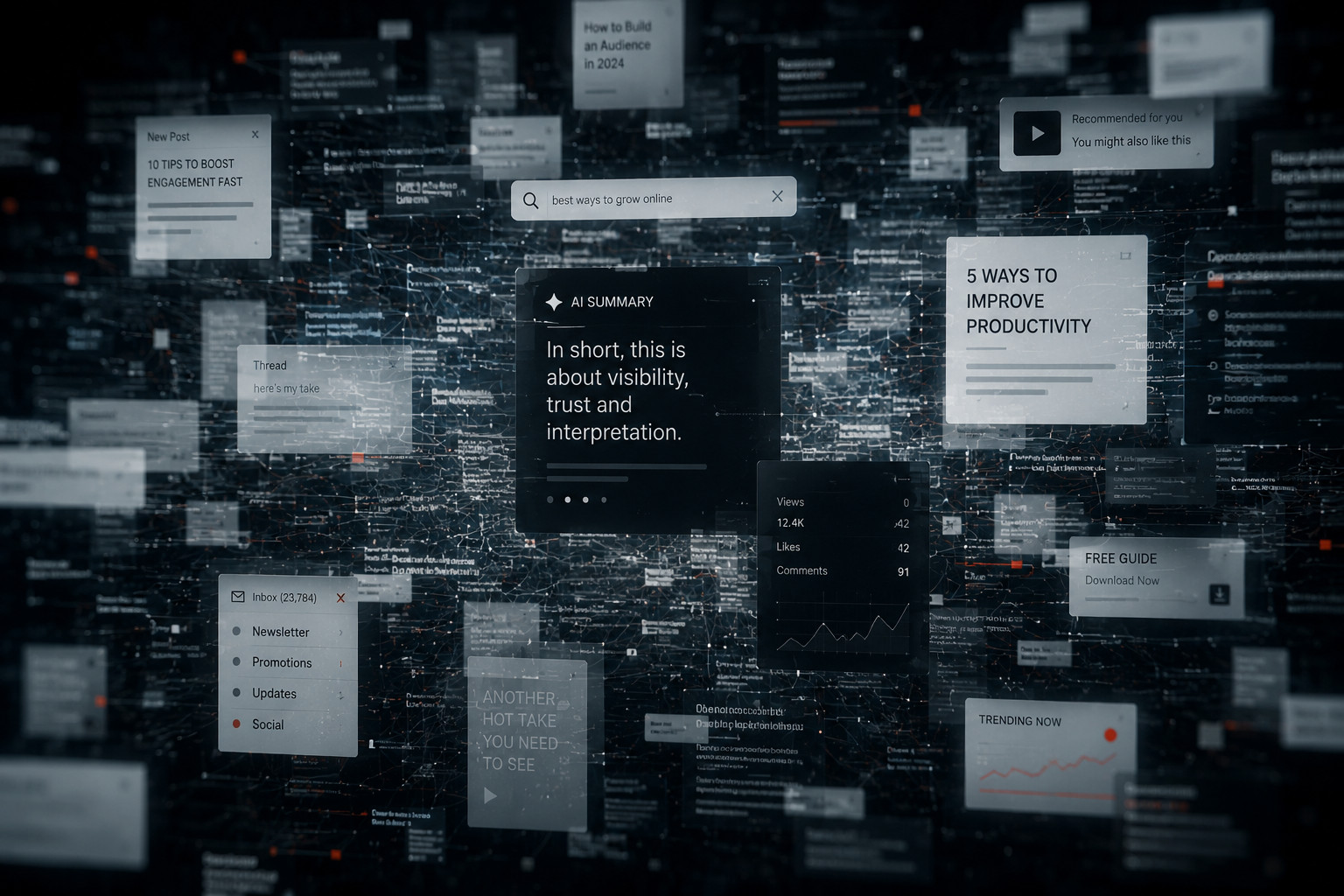
The Hidden Cost of Cognitive Overload
One of the least discussed aspects of the interpretation economy is cognitive exhaustion.
Modern people are overwhelmed.
Not merely by information. But by:
- decisions
- signals
- options
- platforms
- narratives
- urgency
- contradictory advice
- constant comparison
- fragmented attention
As overload increases, people unconsciously seek:
- clarity
- compression
- orientation
- reassurance
- recognisable pathways
- obvious next steps
This is why:
- clear websites outperform confusing ones
- simple offers outperform complicated funnels
- direct language often outperforms clever branding
- obvious pathways convert better than exploratory experiences
- “start here” works disproportionately well
- cognitive ease increasingly influences trust
In many cases, what converts is not persuasion. It is relief.
The Interpretation Economy Rewards Clarity
Clarity is often misunderstood as simplification.
It isn’t.
True clarity is the ability to:
- reduce distortion
- preserve meaning under compression
- communicate relevance rapidly
- orient people effectively
- remove unnecessary interpretation burden
- help others recognise what matters
This is becoming a serious advantage.
Especially in environments where:
- attention is fragmented
- AI intermediates discovery
- people make decisions rapidly
- trust is fragile
- confusion creates hesitation
The businesses and creators that thrive are increasingly those that can:
- be understood quickly
- communicate outcomes clearly
- reduce ambiguity
- guide interpretation intentionally
- maintain coherence across platforms and systems
This does not mean becoming shallow.
It means becoming legible.
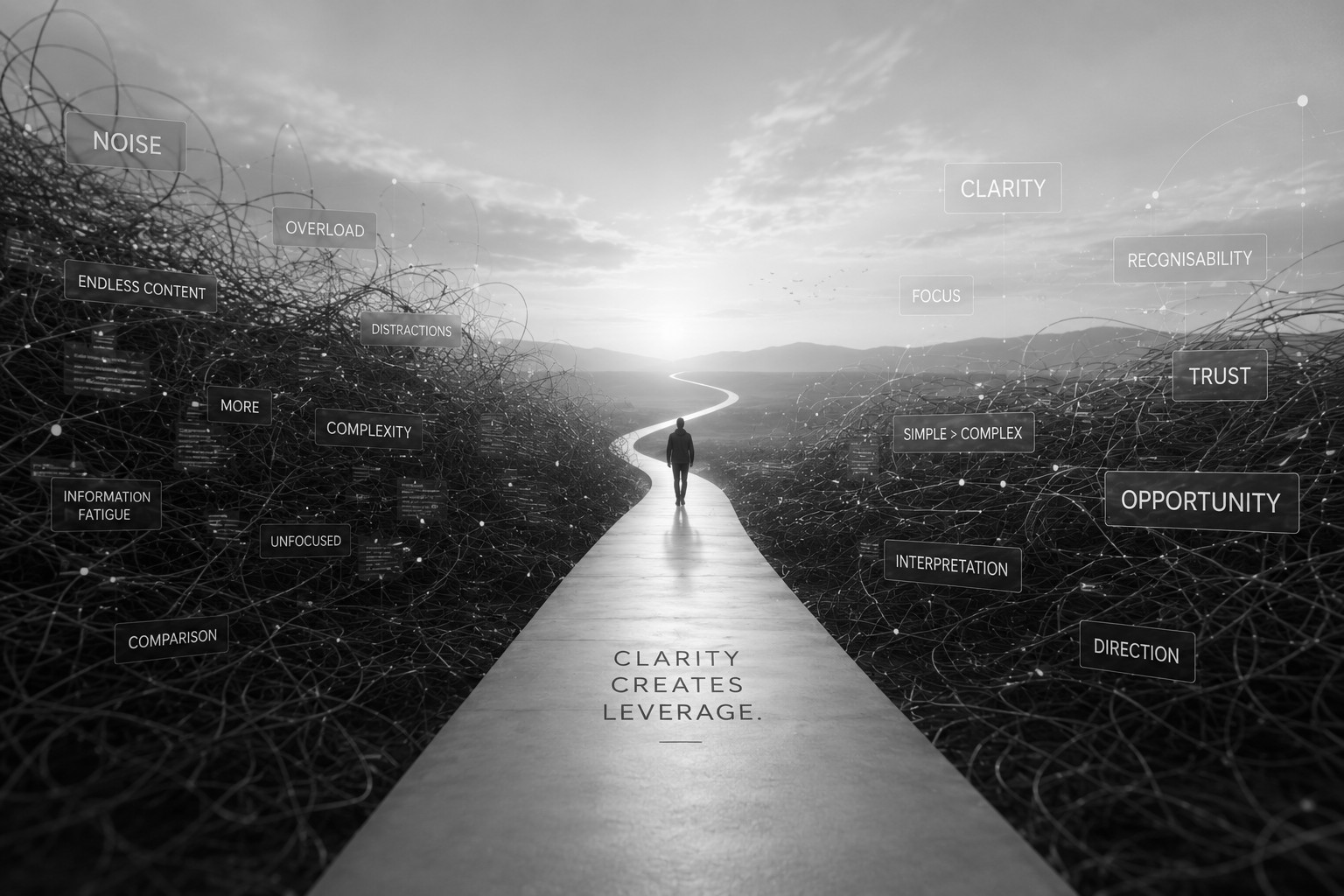
Why Many Good People Feel Invisible
A growing number of intelligent, capable people feel strangely invisible online.
Often the issue is not effort. Nor lack of expertise.
It is that their value does not survive modern interpretation environments.
Examples include:
- experts buried beneath vague language
- creators producing without positioning
- businesses describing features instead of outcomes
- consultants assuming visitors will “figure it out”
- highly nuanced people struggling in systems that reward immediate recognisability
Modern environments increasingly punish ambiguity.
Unfortunately, many thoughtful people default toward complexity, context, nuance, and over-explanation (a tendency I understand well myself, which is partly why my writing is intentionally structured this way: clarity, compression and reduced interpretive friction increasingly matter).
But overloaded audiences rarely reward this.
Instead, they reward:
- recognition
- orientation
- coherence
- trust signals
- clarity of outcome
- emotional certainty
This is not necessarily fair. But it’s increasingly real.
The Shift From Information to Orientation
For years, the internet rewarded information. Now information is everywhere.
AI can generate explanations endlessly. Search can retrieve almost anything. Content volume is exploding.
As a result, a new scarcity is emerging:
orientation.
People increasingly need help determining:
- what matters
- what to ignore
- what to do next
- what signals are real
- how systems interpret them
- where friction exists
- why they feel stuck
- how to regain clarity
This is one reason why judgement, clarity, and interpretation are becoming more valuable.
Not because people suddenly became less intelligent. But because modern environments create distortion at scale.
If you’re trying to navigate this shift practically:
- Everything Feels Important is a short guide to signal, overload and decision clarity in high-noise environments.
- What AI Thinks You Are explores how AI systems and modern platforms may currently interpret your work and positioning.
Explore the PDFs →
Why This Matters for Businesses and Creators
The interpretation economy affects almost every online environment.
Creators:
- are interpreted by algorithms before audiences
- compete against compressed attention spans
- increasingly rely on recognisable positioning
Businesses:
- lose conversions through confusion and hesitation
- struggle when visitors cannot quickly identify relevance
- are judged through clarity as much as competence
Consultants and service providers:
- are filtered through trust and interpretation layers
- often fail because their expertise is difficult to decode quickly
Websites:
- increasingly function as interpretation environments rather than digital brochures
- must reduce cognitive friction rapidly
AI systems:
- increasingly shape discoverability itself
- summarise and reinterpret information before users arrive
In many ways, modern visibility now depends on whether systems and people can correctly understand what you are.
The Future of the Interpretation Economy
The interpretation economy will likely intensify.
As AI systems become more integrated into:
- search
- recommendation systems
- shopping
- education
- hiring
- discovery
- software
- media
- communication
…the importance of interpretation will increase further.
This does not mean humans disappear.
It means humans increasingly interact through interpretive layers.
The people and businesses that adapt earliest will likely:
- communicate more clearly
- reduce ambiguity intentionally
- focus on recognisability
- create stronger orientation
- build coherent signal ecosystems
- understand how systems interpret them
- optimise for trust and clarity rather than noise alone
The winners may not necessarily be the loudest. They may simply be the easiest to understand.
Final Thought
Most people are still optimising for production.
More content. More posts. More tools. More automation. More information.
But increasingly, the real leverage lies elsewhere.
In a world overwhelmed by noise, distortion, compression, and fragmented attention:
- clarity becomes leverage
- judgment becomes infrastructure
- interpretation shapes outcomes
- recognisability creates opportunity
- confusion creates invisibility
The interpretation economy is not merely about AI.
It is about the growing economic importance of how people and systems understand each other.
And in that environment, the ability to reduce distortion and create clarity may become one of the most valuable skills of all.